A glass mousepad can make your mouse feel faster and more direct, but the skates underneath your mouse matter just as much as the pad itself.
The right mouse skates help your setup feel smooth and predictable. The wrong ones are not bad, they just feel different from what you prefer.
|
QUICK ANSWER: Choose UHMW-PE Dot Skates for durability and a smooth, consistent feel. Choose PTFE Dot Skates for the lightest, fastest glide. Choose PTFE Donut Skates for smoother movement with more stability and control. |
Why Mouse Skates Matter More on Glass Mousepads
Glass has a hard, smooth surface with less resistance than cloth. Because of that, small changes in skate material, shape and placement are easier to feel.
Mouse skates do not improve aim by themselves. They help you tune the physical feel of mouse movement. Mouse weight, skate placement, the number of skates installed, and surface cleanliness also affect the result.
Quick Comparison: UHMW-PE vs. PTFE Dot vs. PTFE Donut
|
OPTION |
MATERIAL / SHAPE |
GLIDE FEEL |
MAIN FOCUS |
BEST FOR |
|
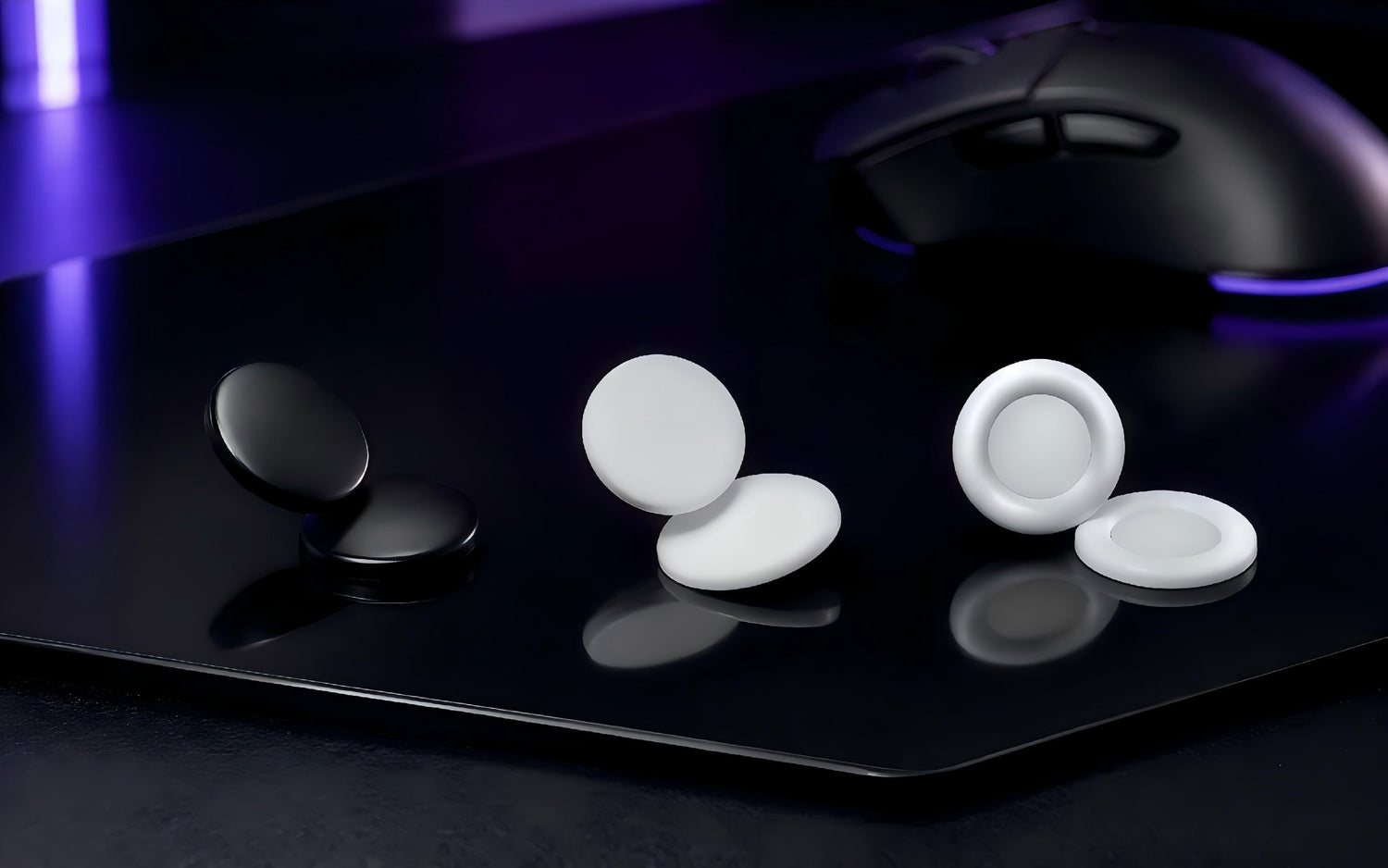
Obsidian Black UHMW-PE Dot |
UHMW-PE dots |
Smooth and consistent |
Durability and consistent glide |
Long-lasting performance |
|
Arctic White PTFE |
PTFE dots |
Fast and smooth |
Maximum glide |
Light, fast movement |
|
White Orbit PTFE Donut |
PTFE donut rings |
Smooth and stable |
Balanced control and stability |
A controlled everyday feel |
This comparison is a starting point, not a rule. Your mouse, your desk setup, and your preferred feel still matter.
UHMW-PE Dot Skates: Smooth, Consistent, and Durable
UHMW-PE is a durable plastic material that can provide a smooth, consistent glide on glass and other hard mousepad surfaces.
The Obsidian Black UHMW-PE Dot Mouse Skates are built for players who want long-term consistency rather than pure speed. Choose UHMW-PE Dot Skates if you use a hard mousepad regularly, prefer predictable movement, and do not want speed to be the only priority in your setup.
PTFE Dot Skates: The Lightest and Fastest
PTFE, or polytetrafluoroethylene, is a low-friction material commonly used for mouse skates.
Arctic White PTFE Mouse Skates use a small dot design, so there is less contact with the pad. That gives you a lighter feel and quicker starts.
Choose PTFE Dot Skates if you prefer speed and are comfortable adapting to a faster setup.
PTFE Donut Skates: Smooth and Stable
PTFE Donut Skates use a ring-shaped design with a wider support area than standard dot skates. The result is a smoother, more stable feel that sits between maximum speed and heavier control.
CLUSTRS White Orbit PTFE Donut Mouse Skates are designed for balanced control and stability. They are a practical option for players who want smooth movement without making the mouse feel overly loose. For most mice, four outer ring skates are a good starting point. The center pieces can also be used separately as dot-style skates for later adjustments.
Which Mouse Skates Should You Choose for a Glass Mousepad?
Choose UHMW-PE for Long-Term Consistency
Choose UHMW-PE Dot Skates if durability and a familiar, predictable glide feel matter most. They are a practical choice for regular hard-pad use.
Choose PTFE Dot for Maximum Speed
Choose PTFE Dot Skates if you prefer low resistance, quick starts, and the lightest movement in the CLUSTRS lineup.
Choose PTFE Donut for Balanced Control
Choose PTFE Donut Skates if you want smooth movement with more stability and controlled tracking. They are a useful middle ground for gaming, work, and everyday use.
How to Install Mouse Skates Correctly
● Remove the old skates and any remaining adhesive.
● Clean the skate grooves with an alcohol wipe.
● Align the new skates with the mouse foot areas, then apply them flat.
● Press each skate down firmly for a few seconds before testing the mouse.
If a skate is uneven or partly lifted, replace it. An uneven installation can affect the feel more than the difference between two skate materials.
When Should You Replace Mouse Skates?
There is no fixed replacement schedule. Skate wear depends on playtime, mouse weight, movement pressure, surface type, and how clean your setup is.
● The glide feels rough, scratchy, or uneven
● New scratching sounds appear
● The skates look thin, worn, or damaged
● The mouse shell begins touching the pad
Final Thoughts
Choosing mouse skates for a glass mousepad is about tuning your setup, not finding one universally perfect option. Start with the glide feel that matches your current preference, keep your mousepad clean, and give yourself a few sessions to adapt before making another change.
Choose UHMW-PE Dot Skates for durability and consistent glide. Choose PTFE Dot Skates for the lightest, fastest movement. Choose PTFE Donut Skates for a smooth, stable, more controlled feel.
FAQ
Are UHMW-PE or PTFE skates better for glass mousepads?
Both are suitable. UHMW-PE is a good choice for durability and consistent glide, while PTFE suits players who want a lighter, faster glide.
Are PTFE Dot Skates faster than PTFE Donut Skates?
In general, PTFE Dot Skates provide a lighter, faster glide. PTFE Donut Skates provide a wider support area and a more stable, controlled feel.
How many Donut Skates should I use?
For most mice, start with four outer ring skates. Test the feel before adding or changing anything else.
Can I use glass or ceramic skates on a glass mousepad?
For CLUSTRS glass mousepads【https://theclustrs.com/collections/all-products】, PTFE and UHMW-PE are recommended. Glass-on-glass and ceramic-on-glass combinations can create extra noise, unpredictable wear, or surface stress.
Do new mouse skates need a break-in period?
A new set can feel different at first. Play for a few sessions on a clean mousepad before making major changes to your sensitivity or setup.